
What this is
Burning Japan is Japan's official regional burn of Burning Man, the event held in Nevada's Black Rock City. It began in 2012 with three people, and it has never had a seat for spectators.
Art, sound, and food arrive as gifts. Nothing is sold on site. The fixed ritual is to build a phoenix and burn it near the end. In 2026 there was also a temple, and a yokai-bon fire on Saturday evening. Which fires happen in 2027, and at what hour, has not been announced.
The 10 principles
The way this city lives follows Burning Man's 10 principles, in the official order, from Radical Inclusion through Immediacy. The canonical text is on burningman.org. This site's principles page is how Burning Japan reads them on a ranch in Japan.
If this is your first time
This is not a show staged for customers. There is almost no power and no drinking water, and apart from the toilets you improvise. People have arrived with one shisha, or one box of apples, and left laughing. A first-timer's clumsy mistake is not the same thing as harming someone.
If the gear is the thing stopping you, Volunteer Camp is the official door. In exchange for shifts you get a tent, a kitchen, and help from the station. You do not need a perfect pack. Not knowing is different from doing harm.
The law, and this land
The site is a ranch in the woods. A wildfire would not just end the year. It would end the event. Drones, generators, fireworks, and large flame effects are by permission. In 2026, generators and propane tanks were forbidden in open camping. Portable power stations were allowed.
Pets cannot come in. Through 2026, children under 12 were free, and anyone under 18 came with a guardian. When 2027 ticket types are published, age rules will be updated on the tickets page.
Gifts, and leaving no trace
A gift is not a trade. A pour into someone's own cup, a hand with a tent, one volunteer shift, or some firewood can all be a gift. Anything handed out as promotion is not a gift. Check age before pouring alcohol, pour only when they clearly want it, and stop when someone declines.
Strip packaging at home. Do not bring paper plates, paper cups, disposable chopsticks, glitter, or confetti. Oily cooking makes greywater. Ash and trash go home with you. If the wind can take it, do not set it down.
- By car, plan on roughly 3 liters of drinking water per person per day, for drinking and cooking.
- By train, bring at least one 2-liter bottle. In 2026 there was extra drinking water for people who came by transit.
- Use meat and dairy early, then shift to food that can sit out. You cannot restock ice.
- Some years, bottled ice was given out at Center Camp or Volunteer Camp.
Getting there, and the road
The site is Aisai no Kane at Tsumagoi Bokujo, 2401 Hosomata, Tsumagoi, Agatsuma, Gunma. About three hours by car from Tokyo. The usual route is Kan-etsu and Joshin-etsu toward Usui-Karuizawa, then the Manza Highway. The Shiga-Kusatsu road via Kusatsu is sometimes closed at night. Check the road before you leave.
By train, JR Agatsuma Line to Manza-Kazawaguchi, then a Seibu bus about 21 minutes to Tsumagoi Bokujo / Aisai no Kane. There are only about three buses a day. The timetable changes with the season. Check Seibu before you travel.
Between the parking area and the city you walk the shoulder of a toll road built for cars. A headlamp is what you need at night. A phone light is not enough. Step into the lane and you are in front of traffic that cannot easily avoid you. A crash there can stop the event.
What to pack, and the cold
An October pasture is workable by day and a winter camp from night into dawn. In 2024 one morning reached about 3°C. Bring an autumn-to-early-winter sleeping bag, a sleeping pad you cannot skip, and a light hat if you want to sleep. Rain and dew want a coat and spare socks.
Down takes spark holes. Near a fire, put an old layer or a blanket over it.
- Your Peatix ticket and ID. A passport if you are not a Japanese national.
- A headlamp and spare batteries. Do not use your phone as a light.
- One or two power banks. Charge the bank, and do not hand your phone to someone to charge.
- Tent, bag, pad. Your own cup, plate, and utensils.
- Trash bags and a pocket ashtray. Your own medicines and a small kit. The event medical box does not dispense drugs.
- Earplugs. The city does not have lights-out.
- Cash for onsen and shops on the way. You cannot buy anything on site.
- A little firewood, cut to length, roughly enough for four burns.
2026 gate hours, for reference
The 2027 timetable is not published. This is the most recent pattern on the same ranch. In 2026, once you had checked in you could come and go overnight. Without check-in you could not park or enter.
- Thursday 8 October, gates at 12:00. Check-in 12:00–21:00. 20:00 From the Ashes.
- Friday 9 October, check-in 10:00–21:00.
- Saturday 10 October, check-in 10:00–21:00. 17:00 yokai-bon fire. 22:00 temple burn.
- Sunday 11 October, check-in 10:00–18:00. 19:00 phoenix burn.
- Monday 12 October, close at 18:00, LNT Day. The street reopened to camps at 12:00.
- Tuesday 13 October, DBK Day until 15:00: hand the ranch back and return rented gear.
- Theme-camp and art vehicles had to be out before the street closed at 19:00 on Thursday.
Where you camp
Open camping fills outward from the center, in the order people arrive. The 2026 plan used about 4 square meters a person, with no ropes between plots. You cannot park a car beside your tent. The ground is rough. Unload in the lot and walk the load in.
Theme-camp and art plots were held until 19:00 on Thursday, then opened. Large structures, generators, and vehicles that are part of a work needed art-support registration in advance.
Loud camps and people who want to sleep are placed apart. Voices still carry. If you want quiet sleep, bring earplugs. There is no lights-out.
What is there, and what is not
There is a gate, Center Camp, a medical post, and portable toilets. Some years there was non-potable water. People who came by train had drinking-water support.
There is no food, no shop, no dish pit, no drinking tap, no streetlights, no trash cans, no lockers. In 2026 the sense on site was that every carrier worked, somewhat. Assume it will not, and meet at Center Camp.
Onsen are off site. Manza and Kusatsu are the near ones. Leaving around 10:00 to 14:00 is the easier window. Manza has been relatively tattoo-friendly. People reported getting into Nisshinkan and Hokukokan. Houses change their policy. Check before you go.
Fire, bodies, harassment
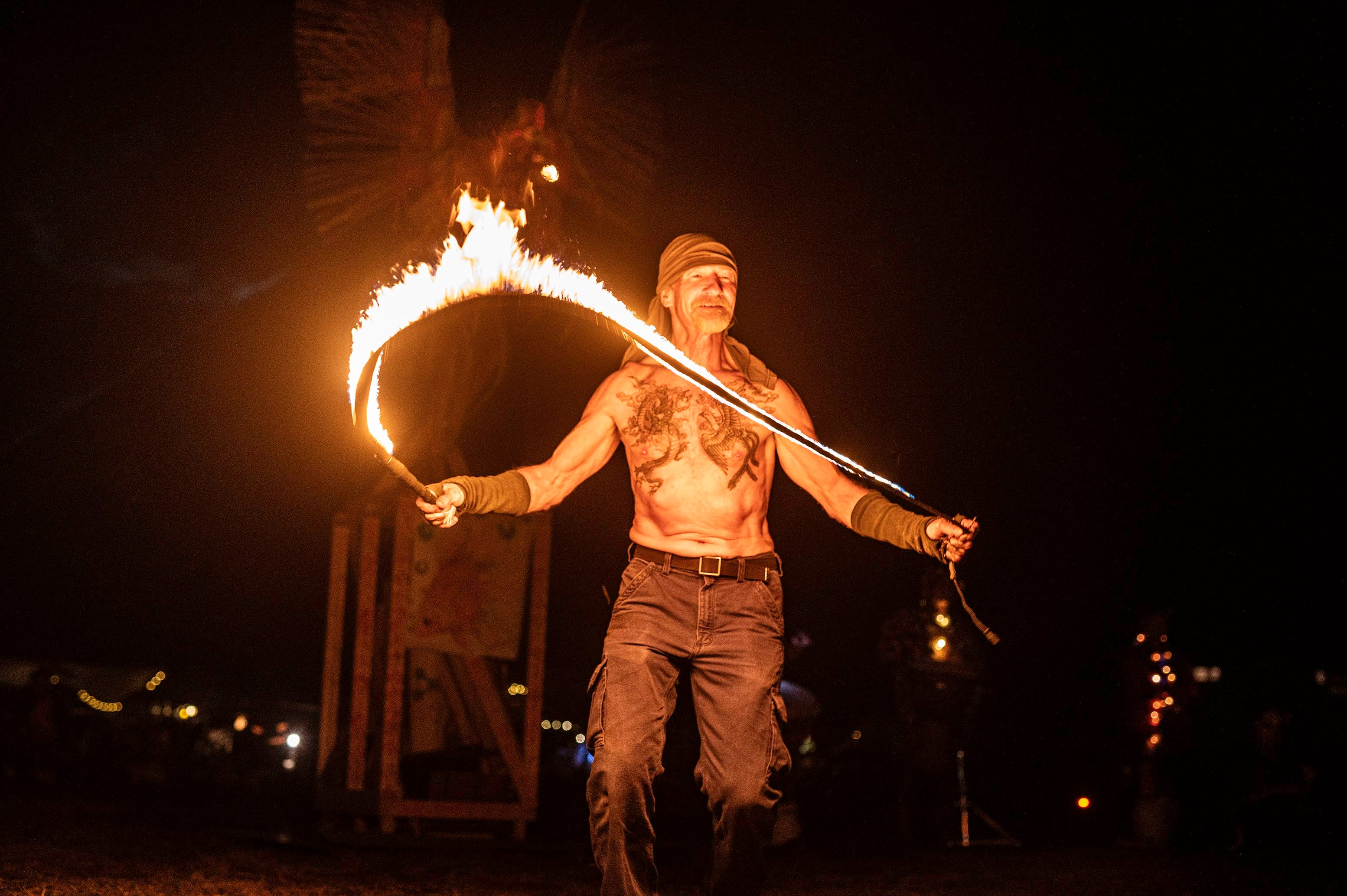
A fire needs a pan, a sheet, and water. Coals and ash go home. Fire performance and large flame need a Fire Pass. The mountain dries out.
There are insects and animals. Carry your own medicine. For an emergency, 119. Past Tsumagoi years pointed people to Nishi-Agatsuma Welfare Hospital in Naganohara (0279-83-7111), Haramachi Red Cross in Higashi-Agatsuma (0279-68-2711), and Saku Central Hospital on the Nagano side (0267-82-3131). Numbers can change.
Unwanted touch, sexual remarks, and pushing alcohol or drugs are not gifts. If you are in danger now, call 110. Afterward there is an anonymous report form. A red wristband has meant: do not photograph me, and do not post me. Ask before you shoot.
The core of the pack
Do not skip
- Ticket and ID
- Headlamp and spare batteries
- Sleep system and rain gear
- Water, food you will finish, your own dishes
- Trash bags
Strongly recommended
- Your medicines and a small kit
- Cash
- Earplugs
- A power bank
- Something to gift. Firewood counts. So does time